How Kids’ Cognitive thinking works in New Jersey. Cognitive thinking is how your kids, teens, and adults brain takes in information from the world, understands it, and turns it into an action or a choice!
But how child cognitive thinking works nowadays? How does it look like? Why you should be aware about its mechanism first and foremost?
What is Cognitive thinking
At its simplest terms, cognitive thinking is the process of thinking and understanding – it is the way kids think!
What is Cognitive thinking
Latin Roots: The word is derived directly from the Latin verb cognoscere, which means “to know” or “to get to know”
“cognitive” is itself the scientific and psychological term used to describe conscious intellectual activity, while the noun form is cognition – Merriam Webster
How Kids’ Cognitive thinking works in New Jersey
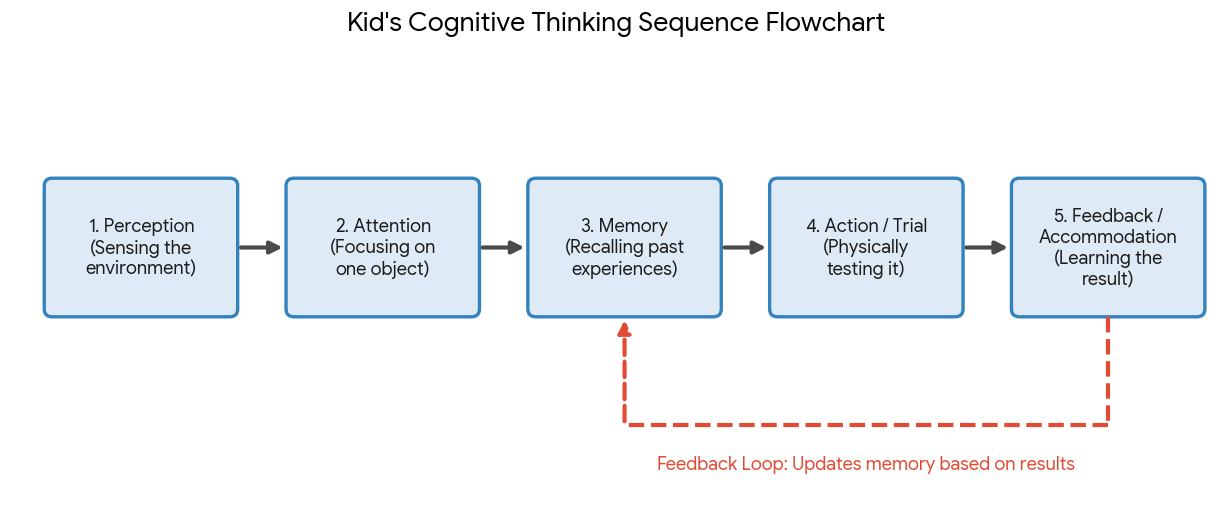
To give you basic and simple understanding about it see the sequence below.
Perception (Sensing): The child gathers raw data using their five senses. They look at a bright object, hear a loud sound, or touch a textured toy.
Attention (Focusing): Out of all the noise around them, the child locks their focus onto one specific thing (e.g., “Look, a red button!”).
Memory (Connecting): The child searches their brain for past experiences. They recall a rule or a previous event (e.g., “Last time I pushed a button, it made a funny sound.”).
Action / Trial (Doing): Kids learn by doing. Instead of weighing abstract pros and cons in their head, they physically test their thought (e.g., They push the button).
Feedback / Accommodation (Learning): The child observes the result. If something new happens, their brain adapts and updates their memory for next time (e.g., “Oh, this button turns on a light instead of making a sound!”).
How Kids’ Cognitive thinking works in New Jersey
👶 Age 0 to 2 Years: The Sensory-Reflex Sequence
Sensorimotor Stage
Children think entirely through physical actions, senses, and motor movements. They have no concept of abstract thought or future planning.
The Cognitive Sequence: Sensory Stimulus
Involuntary Attention
Reflex Physical Action
Neural Wiring
🧸 Age 2 to 7 Years: The Symbolic-Imaginative Sequence
Preoperational Stage
Children can now use symbols, words, and mental images to represent the world. However, their thinking is egocentric (they cannot see other perspectives) and highly reliant on fantasy rather than strict logic.
The Cognitive Sequence:
Perception
Symbolic Association
Imaginative Trial
Immediate Consequence
Example: A 4-year-old sees a cardboard box (Perception). They mentally associate it with a spaceship (Symbolic Association). They hop inside and pretend to fly (Imaginative Trial), operating completely on impulse without considering whether a box can actually fly.
🏫 Age 7 to 11 Years: The Concrete-Logical Sequence
Concrete Operational Stage
How They Think: True logical thought begins here. Children can now perform mental operations and understand concepts like time, space, and volume—but only if they can see or touch it. They struggle deeply with hypothetical or abstract questions.
The Cognitive Sequence:
Physical Problem
Attention to Variables
Concrete Memory Check
Logical Sorting
Example: A 9-year-old is given three sticks of different lengths (Physical Problem). They carefully look at all three (Attention), remember how to measure size (Concrete Memory), and systematically line them up from shortest to longest (Logical Sorting).
🧑🎤 Age 12 Years & Up: The Abstract-Hypothetical Sequence
Formal Operational Stage
How They Think: This is adult-level cognitive sequence capacity. The teenager no longer needs physical objects to solve a problem. They can think about abstract concepts, moral philosophies, future possibilities, and systematically test hypotheses.
The Cognitive Sequence:
Abstract Challenge
Hypothesis Generation
Systematic Evaluation
Strategic Decision
Example: A 15-year-old thinks about climate change (Abstract Challenge). They brainstorm three different ways a community could reduce plastic waste (Hypothesis Generation), weigh the pros, cons, and financial costs of each option (Systematic Evaluation), and choose the most realistic plan to present to their school board (Strategic Decision).
Pediatricians are an important first resource for parents and caregivers who are worried about their child’s emotional and behavioral health or who want to promote healthy mental development.
In simplest terms, your kids and teens have different ways to react and interpret each sense (hear, see, smell, touch, and feel) and environmental changes.
Parents must be there or just a guardian to guide them from the start otherwise some mistakes will be committed.
Your urgent care can help you on how to guide your kids so just go to any walk-in clinic near you!
What affects the cognitive thinking of a child
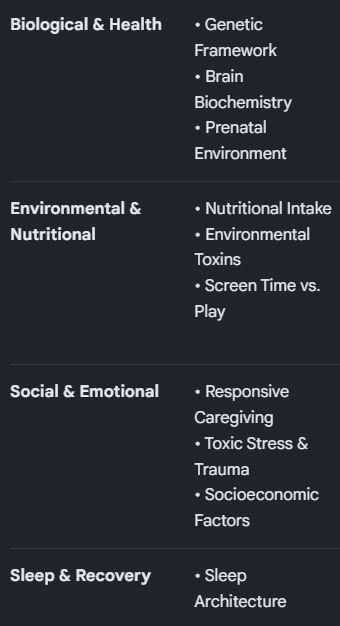
The table below shows the major influencers of your kids cognitive thinking. However, to make it simple, your kids’ environment is the most and critical influencer that affect your kids thoughts!
Literally, it is all about what shapes your kids’ mind!
what affects the cognitive thinking of a child
Everything a child sees, hears, touches, smells, and feels is the raw fuel their brain uses to build thoughts, memories, and logic! Spiritual influence is also a factor so you must be careful!
TIPS AND WARNINGS:
When a child gestures, points, or speaks, respond directly with focused eye contact, descriptive words, or touch to physically strengthen developing neural pathways.
Minimalism is the ultimate shield for a child’s developing brain. By stripping away competing stimuli, you remove the crossroads entirely and allow them to succeed in their natural learning loop
Sleep is when the brain executes memory consolidation, converting daily experiences and lessons into permanent knowledge.
Ensure the child’s diet regularly features adequate protein and critical micronutrients—specifically iron, iodine, and omega-3 fatty acids—which provide the direct building blocks for high processing speeds and mental stamina.
Strictly monitor digital media consumption. Excessive exposure to rapid-fire social media algorithms can overstimulate dopamine pathways, train the prefrontal cortex to expect instant gratification, and shorten attention spans.
Talk to your doctor if you need more information about your child brain cognitive thinking. Your urgent care can help one way or another!
American Academy of Pediatrics (AAP) said Mental health is an essential component of overall health. Mental health challenges—from individual symptoms to diagnosed conditions—impact all children, adolescents and families.
✨ Have questions about this article?
Our AI Assistant can instantly help you find the closest open location, check service details, coordinate a walk-in visit, and answer basic symptoms.